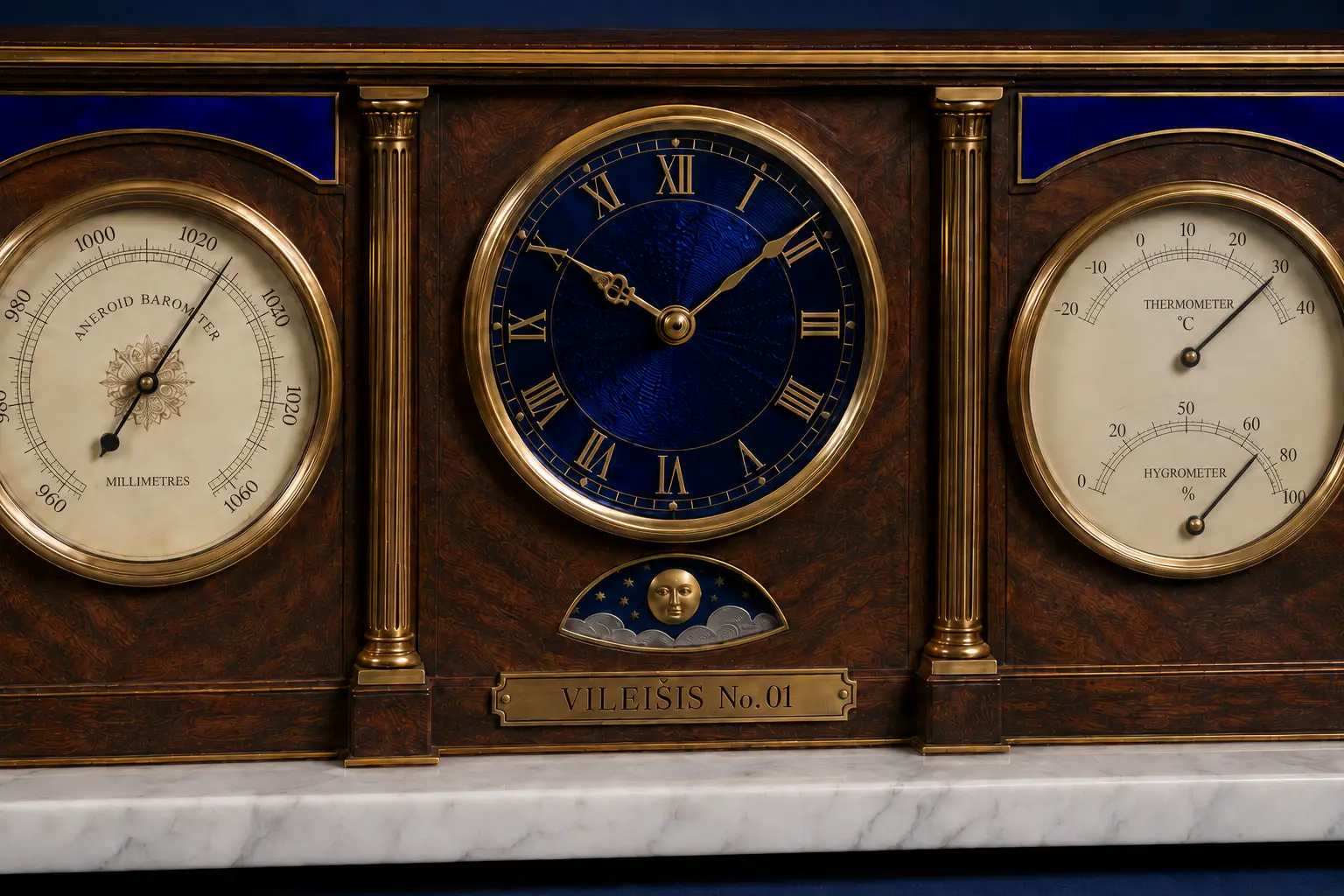
It is easy to generate a beautiful fictional object once. It is much harder to make that object survive a second view.
A front image may suggest a complete design while concealing every unresolved decision. The moment the camera moves closer—or around the back—the illusion is tested. A dial changes size. A fourth gauge appears. A decorative panel acquires a drawer beneath it. Materials meet at a junction that did not exist in the original object.
The Blue Brass Archive treats those contradictions as design errors, not as harmless variations.
The master object comes first
Before a dossier receives multiple images, the object needs a fixed specification. The specification does not have to be a working engineering drawing. It does need to answer the questions that control appearance: overall dimensions, silhouette, number of primary components, component placement, materials, colour, repeated ornament and the relationship between the front, sides, back and base.
For Vileišis No. 01, the rule is explicit. It is a low horizontal cabinet, not a tower. It has exactly three main circular instruments, exactly two fluted brass columns, exactly two upper cobalt-enamel panels, one moon-phase window and one flat marble plinth. Those facts remain true in every image.
Function should be readable
Visual plausibility is not the same as complete engineering, but an instrument must still explain how it is read. The right-hand dial of No. 01 combines temperature and humidity. In an early image, the lower hygrometer pointer ended inside the dial without a clear relationship to its scale. It looked ornamental because a viewer could not tell which value it indicated.
The correction was small but important. The humidity scale became a clear arch. Its pointer received a separate pivot beneath that arch and extended to an identifiable reading of roughly 68–70 per cent relative humidity. No new dial was added. The existing combined instrument simply became legible.
This is the kind of correction that strengthens the fiction. A convincing imagined object does not need to be buildable from the picture, but its visible controls should have a coherent purpose.
Details must come from real locations
A close-up cannot be invented independently from the complete view. If a material photograph shows the meeting of enamel, marble and brass, that exact meeting must exist on the object. Vileišis No. 01 has no enamel section beneath its three principal instruments and no cabinet below the marble plinth. A close-up of such a junction would describe a different object.
The useful detail views are already present: the guilloché clock face; the moon window; a fluted column entering its brass shoe; walnut grain beside an optical-glass bezel; the narrow plaque; and the controlled meeting of walnut case and stone plinth.
Consistency creates history
When the same object appears on a studio background, in a library and on an exhibition plate, consistency does more than prove visual control. It creates the impression of provenance. The viewer begins to recognise the object as something that moved through places and documents while retaining its identity.
That recognition is the foundation of the Archive. A collection should feel as though its records refer to one another: the instrument on the desk is the instrument shown in the exhibition catalogue; the cabinet fits the room; the workshop described in The World could plausibly have produced the materials seen in the dossier.
What a drawing should not promise
The discipline of consistency must not be confused with a promise of technical completeness. An archive plate can be beautifully proportioned and still omit the tolerances, calculations, materials testing and safety systems needed for manufacture.
For that reason, the Archive distinguishes artistic elevations and patent-inspired plates from genuine technical documentation. The goal is to make the world visually and narratively coherent, not to imply that an atmospheric instrument, vehicle or building can be constructed safely from an illustration.
The standard going forward
Every major object will now begin with a master specification and a canonical main view. Later images will be judged against both. If a visually attractive image contradicts them, it will not redefine the object.
That may make the Archive slower to build. It will also make every new record more valuable, because each record will strengthen a world instead of merely adding another picture.