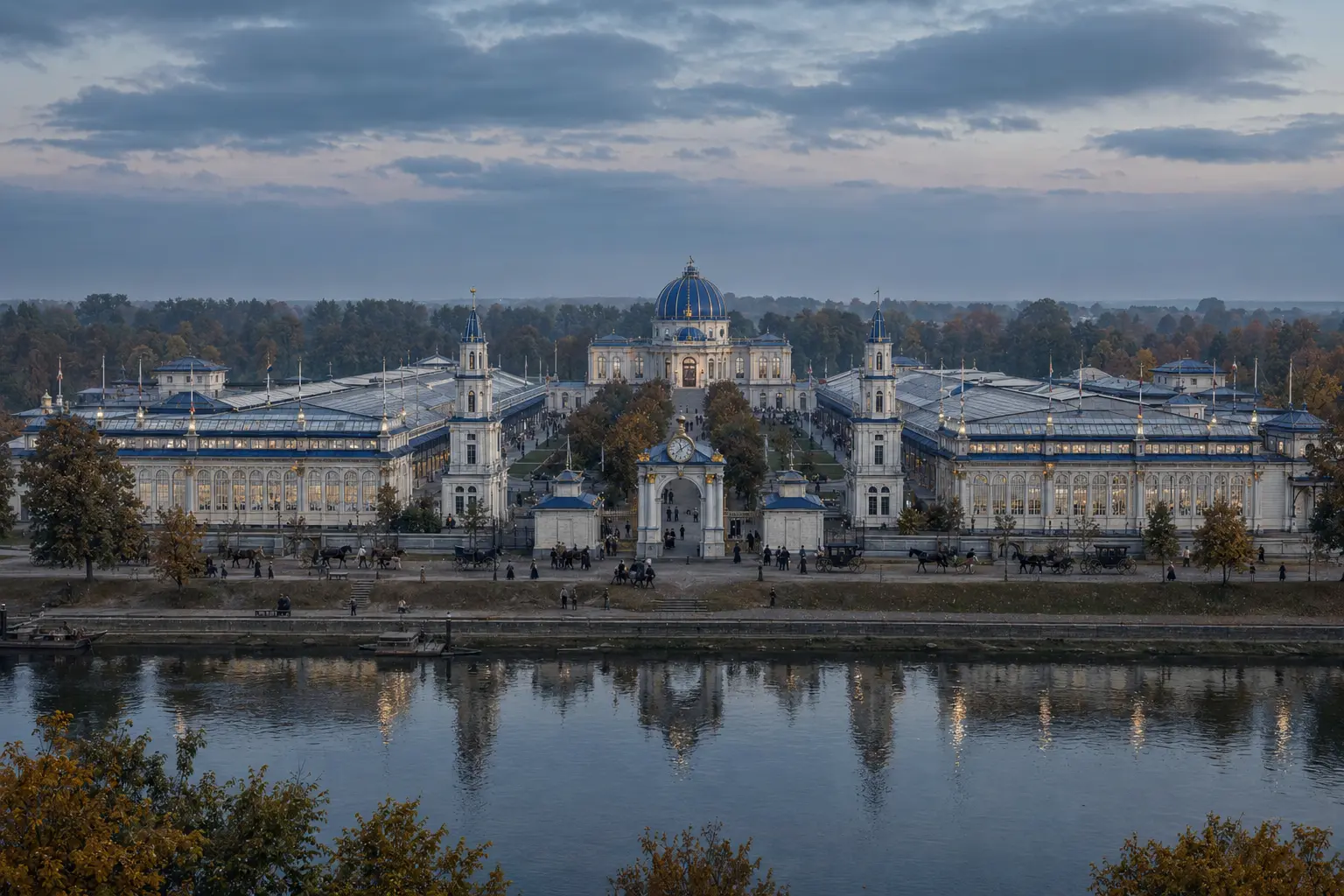
In the autumn of 1898, Vilna acquired, for six weeks, a second city.
It rose beyond the Green Bridge, upon the low bank of the Viliya: white galleries, roofs of glass, slender towers and a blue dome upon which the evening light lingered after it had left the church cupolas and red tiles of the old town.
Not one of those buildings had been intended to endure the winter. Their walls were timber covered in pale lime plaster; cornices that appeared from a distance to be carved from stone had been fashioned from thin sheet metal; broad flights of marble steps proved, upon closer inspection, to be the accomplished work of scenic painters and decorators. Yet while the gates remained open, no one wished to look too closely at the deception. In a matter of months, an entire city had been raised upon an empty riverside meadow, and for the length of one northern autumn it lived with such confidence and ceremony that it seemed to have been built for centuries.
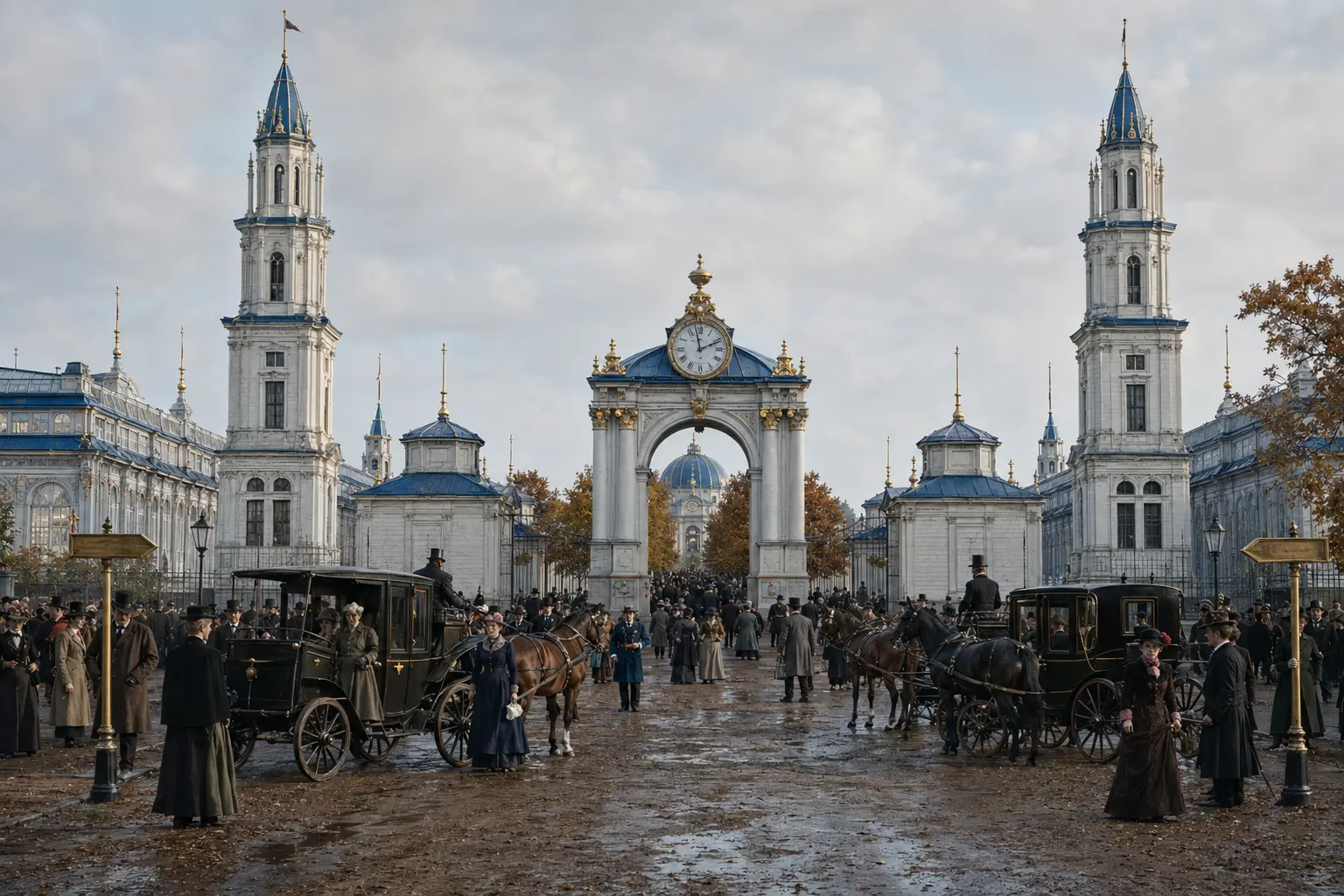
From Cathedral Square, an almost unbroken procession of carriages made its way towards the exhibition. Special omnibuses, distinguished by blue destination boards, met the morning trains. Brass arrows appeared at the principal crossings. In wet weather the streets smelt of coal smoke, damp wool and harness leather; nearer the river, these odours mingled with fresh shavings, machine oil and the lime of pavilion walls not yet entirely dry.
In the official catalogue, the occasion bore the imposing name The Vilna Exhibition of Industry, Instruments and Artistic Crafts. The public shortened it almost at once. In the memory of the city, it remained simply the Vilnius Exhibition of 1898.
A Palace Built for a Single Autumn
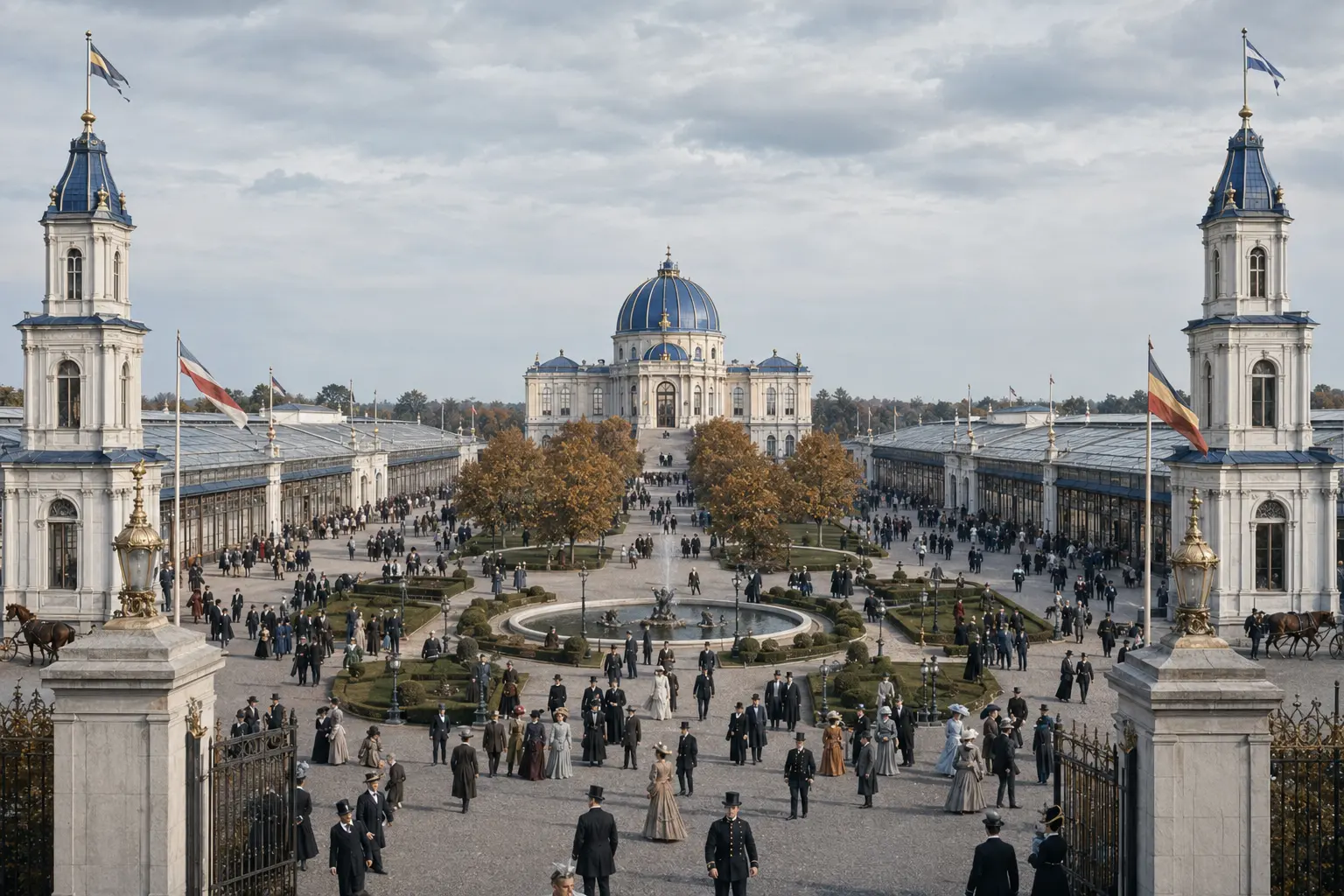
In May, the site had still been a vacant meadow, flooded by the river each spring. By the beginning of September, a ceremonial court extended between two long galleries. Their white façades were crossed by bands of blue metal, and their high windows reflected the water and the unsettled autumn sky.
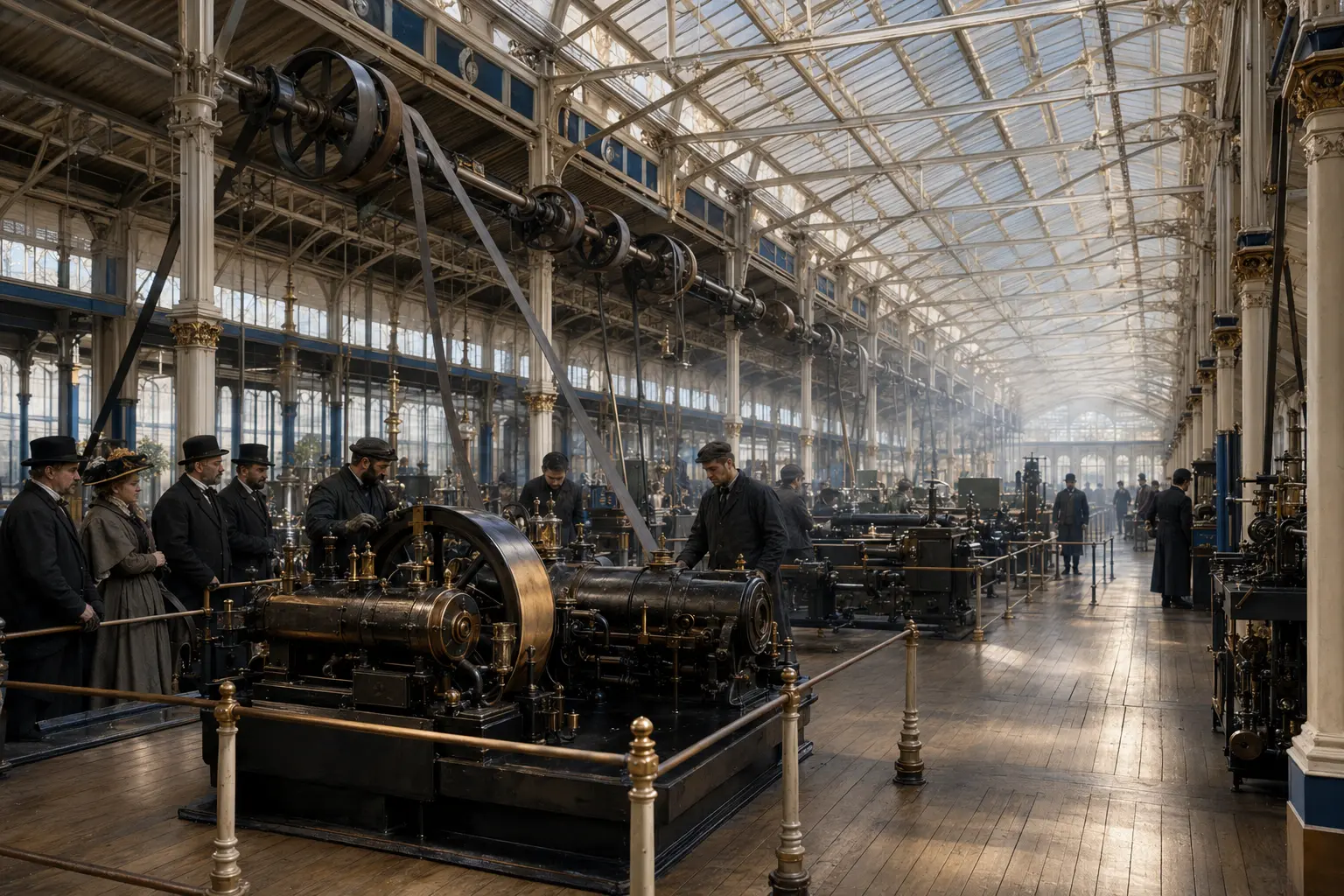
A great clock stood above the central entrance. The eastern wing was occupied by the Machine Court, where wooden floors trembled beneath shafts and belts and where lathes, pumps and compact steam engines worked throughout the day. The western wing was quieter. There the visitor found furniture, domestic mechanisms, optical instruments, architectural models and travelling clothes devised for the new age of railways.
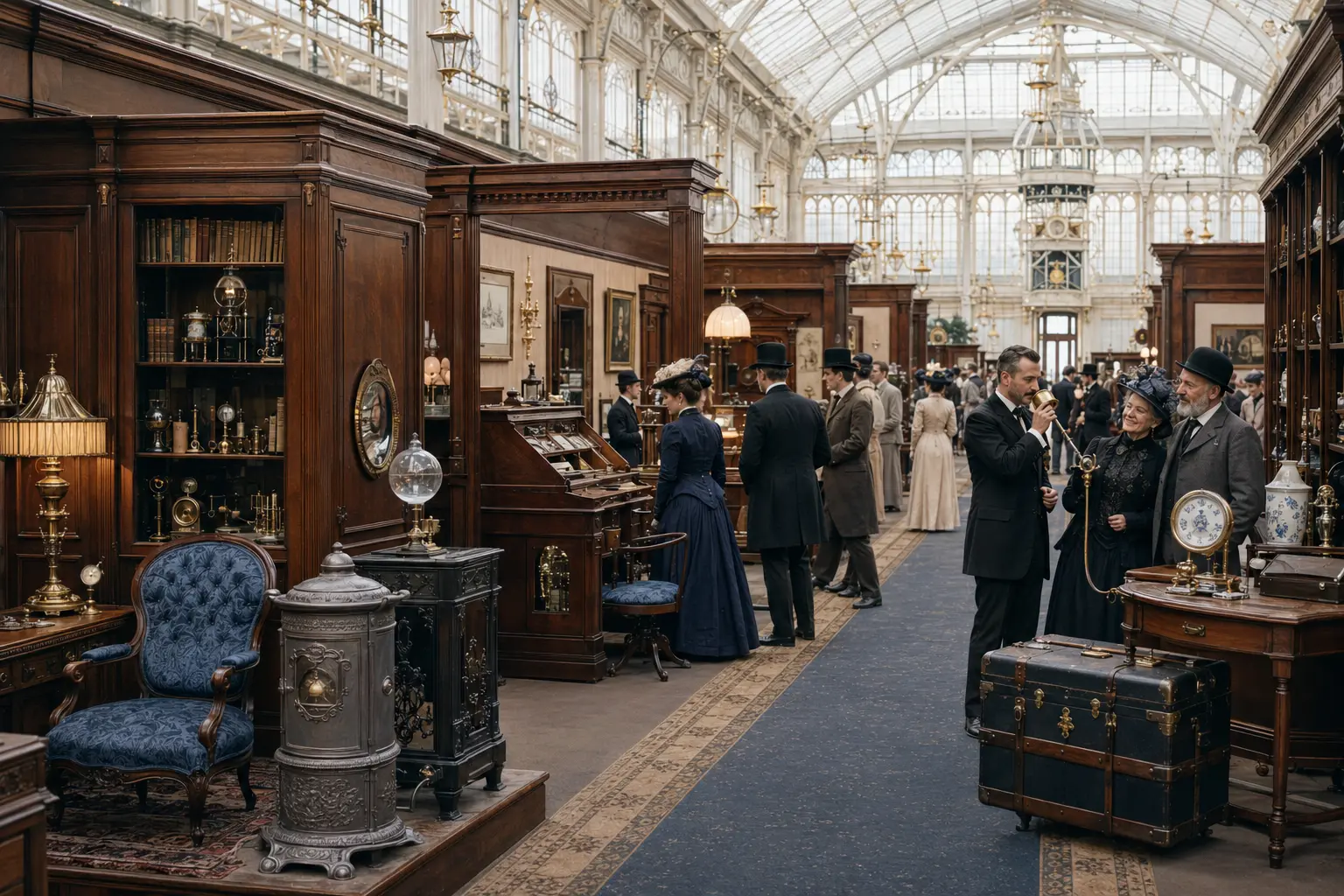
At the far end of the central avenue stood the Observatory Pavilion. Its cobalt dome did not rise above the city’s bell towers; the architect, it was generally thought, had deliberately avoided so presumptuous a rivalry. Low lateral wings and a broad stair gave the building the aspect of neither a temple nor a factory, but of a country palace dedicated to exactitude.
On clear days the dome appeared almost black. After rain it became vividly blue and shone like the enormous enamelled lid of a watch.
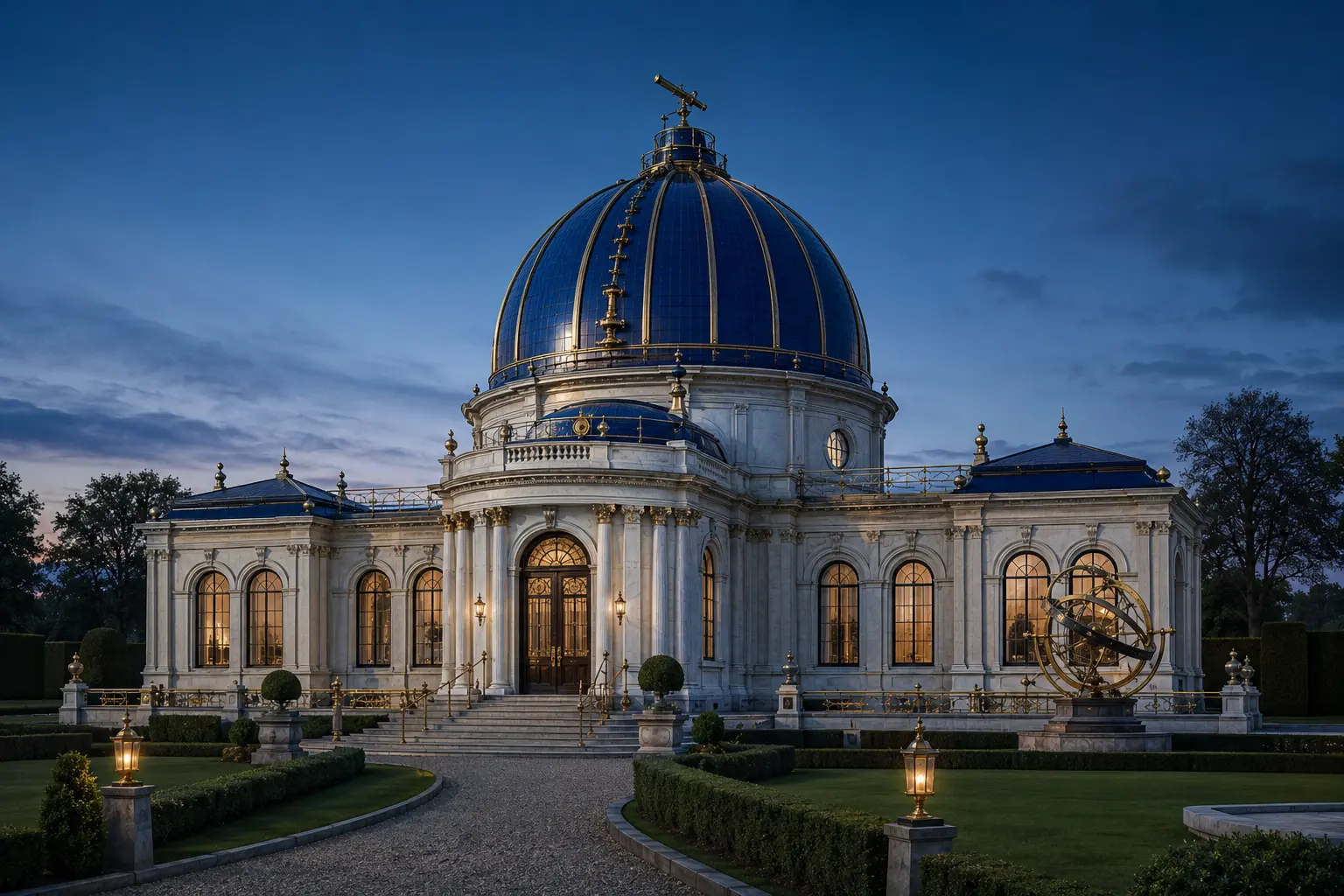
The organisers had studied the exhibitions of London, Paris, Chicago and Nizhny Novgorod, but they made no attempt to surpass those great enterprises in scale. Vilna offered something more intimate and, for that very reason, more persuasive. The machine was not exhibited as a monster consuming coal and human labour. It was brought into the house, cleansed of soot, enclosed in fine wood and metal, and placed beside books, porcelain and the softened light of shaded lamps.
Beneath an engraving of the principal gate, the catalogue carried a sentence that soon became the unofficial motto of the exhibition:
“A useful thing need not apologise for its beauty, nor a beautiful thing for its precision.”
Halls of Measure and Order
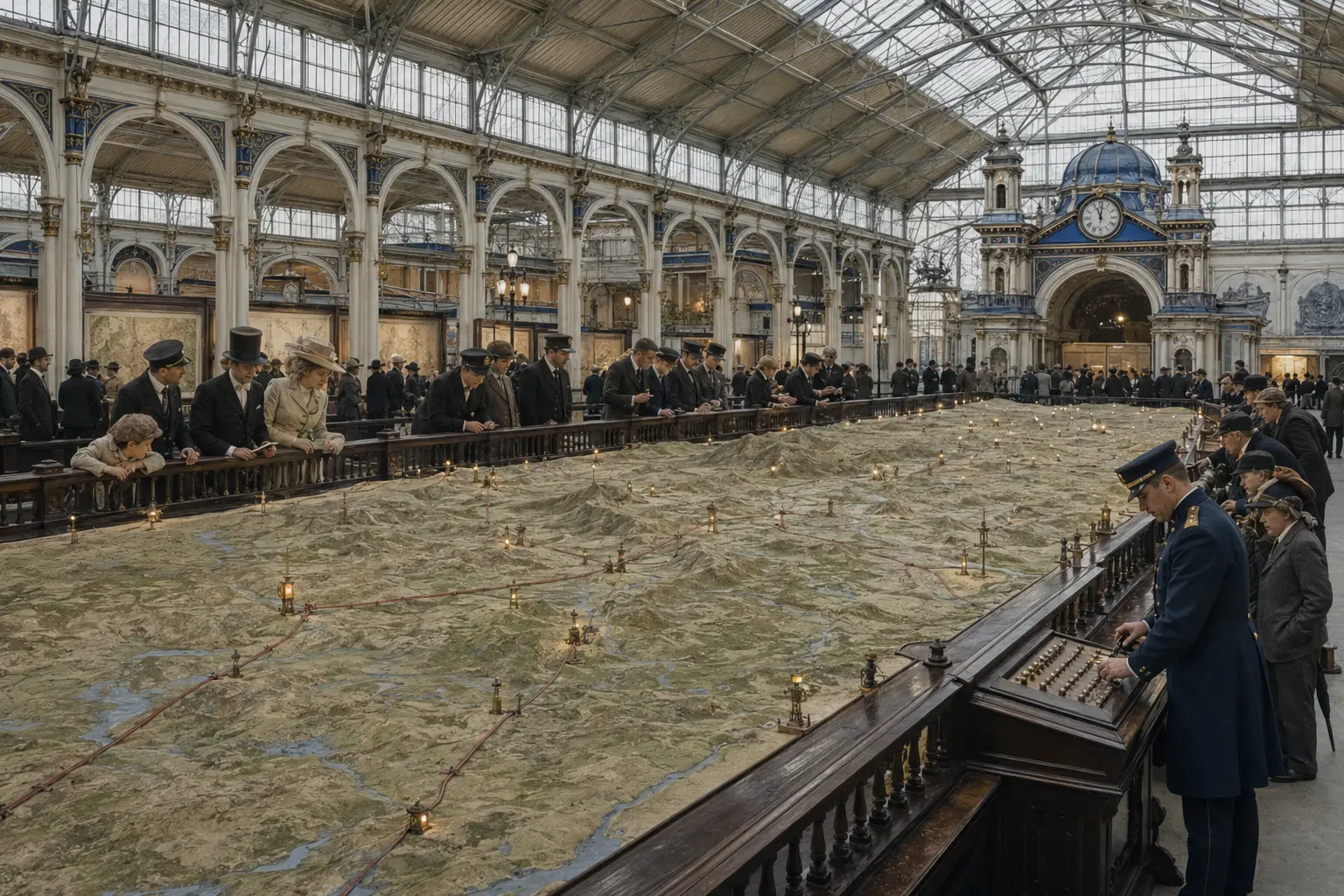
The visitor entered through the Hall of Maps. Railway lines were drawn in red across an immense relief of the western provinces. Small bridges, stations and water towers were marked by metal emblems; at the pressure of a button, a lamp illuminated the route from one city to another.
Beyond it, the exhibition was divided neither by country nor by the names of manufacturers, but by the place an object occupied in human life.
One hall belonged to the city: bridges, stations, street lighting, drains and public clocks. Another belonged to the house: heating, ventilation, locks, bells, speaking tubes and instruments that watched over the air of a room. In the smallest and most crowded cabinets were objects intended for the writing desk, the library, the travelling trunk and the human hand.
This arrangement provoked a considerable dispute.
Factory owners complained that their largest machines had been placed too far from the entrance. Architects objected to seeing designs for palaces and railway stations beside mechanisms in operation. Cabinetmakers disliked the proximity of measuring instruments to their wardrobes and escritoires.
The public, however, understood the principle without explanation. A bridge and a door hinge might belong to the same culture. Each spoke of the manner in which its maker understood strength, order and dignity.
In later years, mechanical fashion would make brass an almost compulsory ornament upon anything unusual. At the Vilnius Exhibition it was employed with greater discipline. Metal emphasised an edge, protected an axle, held a pane of glass or carried a scale. Walnut and oak were not buried beneath gilding. The inscriptions upon porcelain plates possessed the delicacy of watch dials. Cobalt enamel recurred in signs, clocks, stove tiles and the small numbered plaques beside the principal exhibits.
By the end of September, that colour had become inseparable from the exhibition itself.
The Instrument Before Which People Stopped
Three days before the opening, a railway crate lined with felt was delivered to the service entrance of the Gallery of Instruments. Upon its lid appeared the name of the engineer Petras Vileišis.
Inside stood a low case of walnut upon a slab of pale marble. Three circular instruments occupied its façade: a barometer, an eight-day clock, and a combined indicator of temperature and humidity. Beneath the clock, a small aperture showed the phase of the Moon.
The catalogue described the object as Vileišis No. 01 — Atmospheric Observatory.
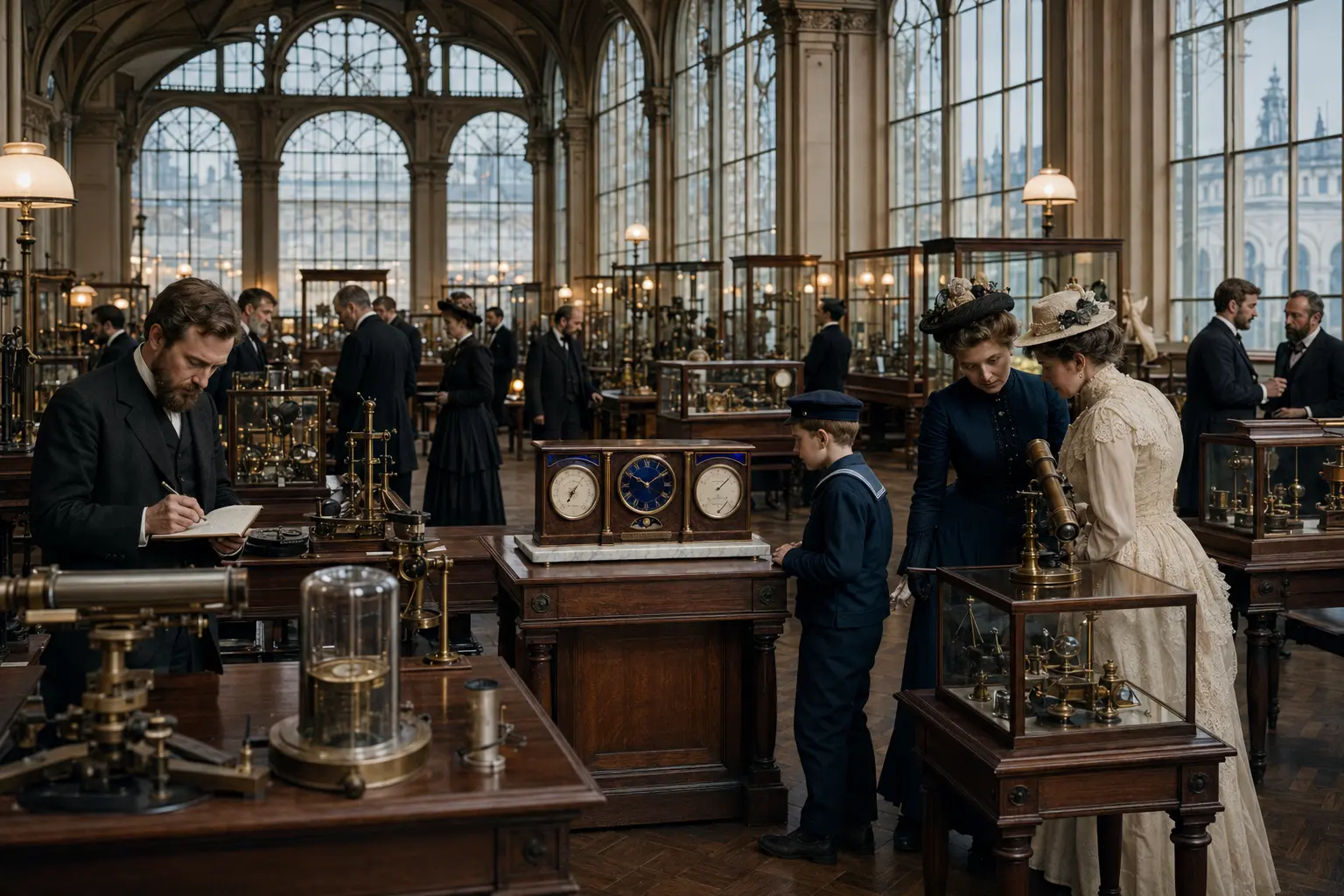
The name struck many as excessively grand and had already become the subject of jokes before the doors opened. The jokes ceased when the instrument itself was seen.
Unlike the exposed clocks and mechanical curiosities surrounding it, the Observatory possessed the composure of serious furniture. Two brass columns divided the front with architectural exactness. Blue enamel was reserved for the central dial and the two upper panels. Nothing turned merely to amuse the public; nothing rang, hissed or produced a shower of sparks.
The instrument did not entertain. It required to be read.
Each morning, an attendant placed beside it a narrow card upon which he entered the pressure, temperature and humidity observed at nine o’clock. Regular visitors began to copy the figures into their notebooks. Physicians compared them with the complaints of their patients. Estate managers argued over whether the instrument would retain its accuracy in a country house. Children returned to see whether the little Moon had moved.
By the second week, the Atmospheric Observatory had attained a rare distinction: it was admired equally by engineers and by people who had no desire whatever to resemble engineers.
One Vilna correspondent called it “an instrument before which even the drawing room need not retreat.”
The organisers were offered money and repeatedly asked when a second example might be completed. Every enquiry received an evasive answer. The brass plate retained the designation “No. 01”, promising the beginning of a series; yet before the exhibition closed, no second instrument appeared.
The Blue Hour
The exhibition was at its most beautiful after sunset.
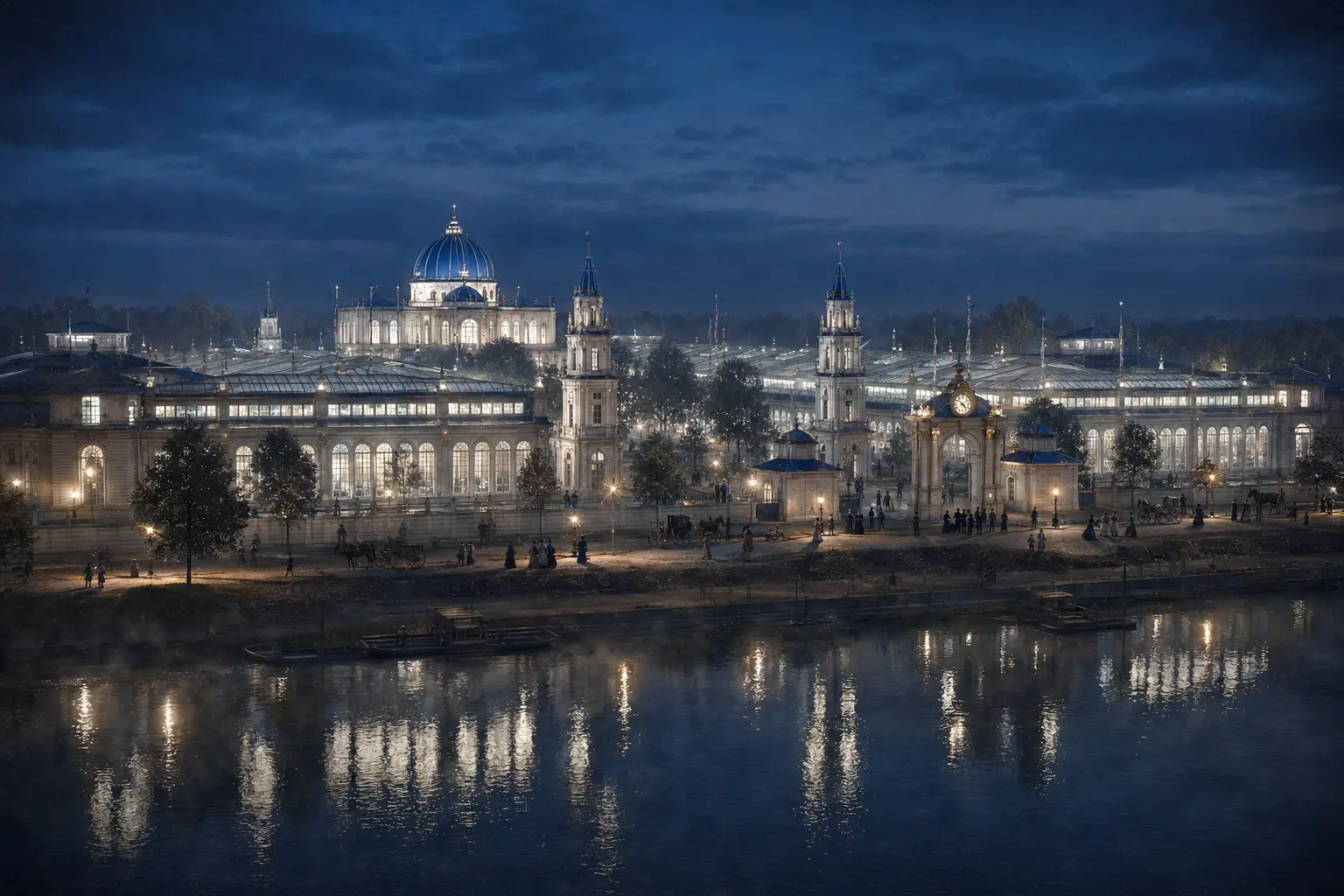
Vilna had long known the warm circles cast by gas lamps, but the exhibition buildings received their light from a small generating station of their own. At half past five, attendants lowered the canvas blinds in the instrument galleries. Then, with a soft crackle, the arc lamps in the central court came to life.
To those who had never seen electric light of such strength, the transformation was almost alarming. Colours grew colder. Brass threw hard reflections across the polished floor. The glazed roofs vanished into darkness, so that the halls appeared to open directly into the night sky.
From the opposite bank, the exhibition seemed to have become detached from the earth. A pale procession of pavilions hung above the black water, crowned by the blue dome. A second, trembling city descended into the river beneath it.
The severity of the new light was softened by music. A small orchestra performed in the western gallery, almost inaudible by day beneath the noise of the Machine Court. Tea was served under palms borrowed from private winter gardens. In dry weather the doors remained open, and the smell of warm oil mingled with that of wet leaves upon the riverside walk.
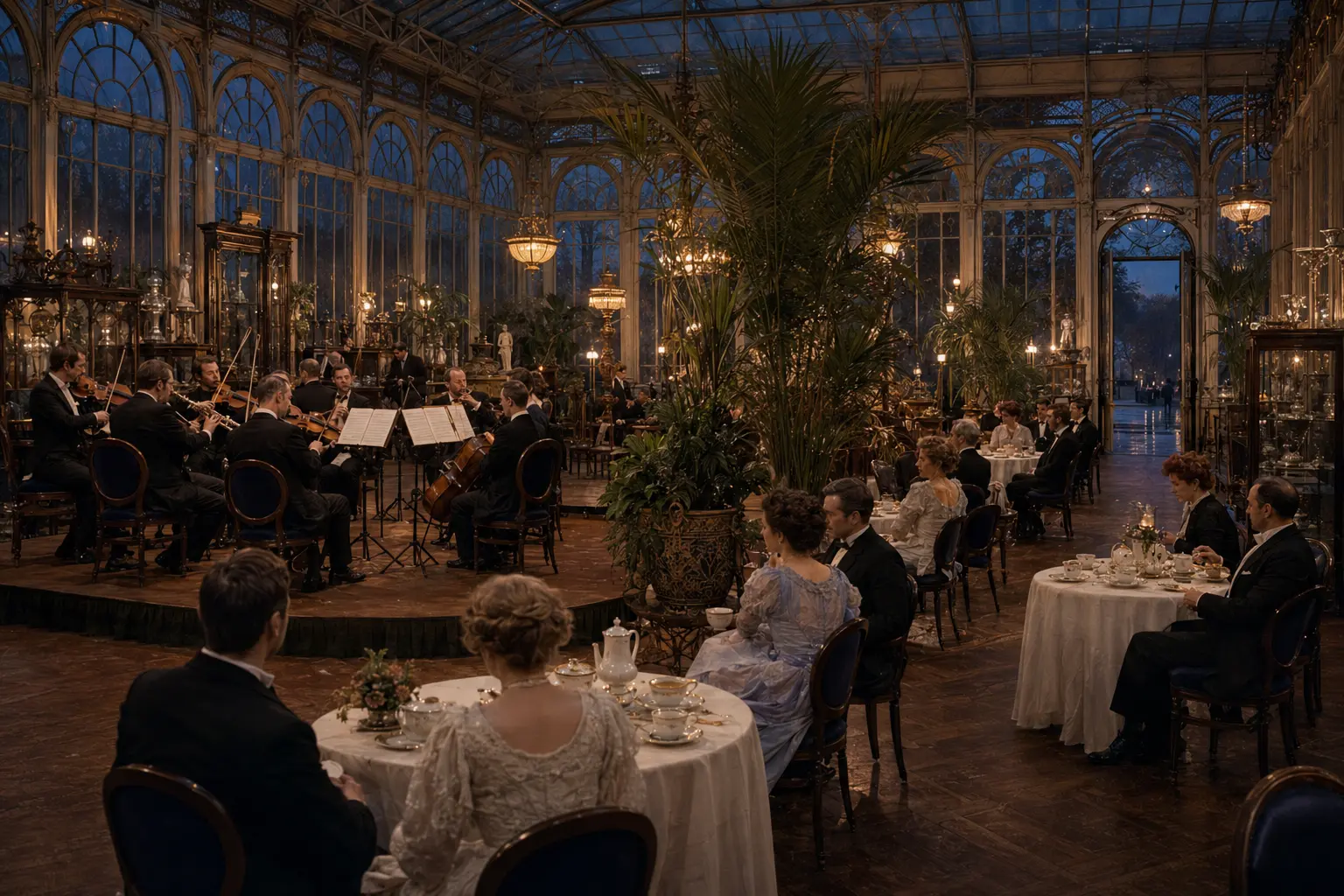
At such an hour, the exhibition ceased to be merely a collection of industrial samples.
People returned without their catalogues. Students lingered beneath the electric lamps. Ladies who had appeared bored by models of bridge supports in the afternoon now studied cabinets, travelling trunks and astronomical clocks at length. After several hours among pumps, boilers and measuring scales, visitors found themselves speaking of what a modern northern city ought to become.
The October Storm
The most famous story of the exhibition began on a clear Friday morning in the first days of October.
The needle of the barometer in Vileišis No. 01 had fallen markedly since the previous day. The attendant removed the customary white observation card and replaced it with a blue one, the sign of a rapid change in the air. At his insistence, the upper windows of the glass galleries were closed and the exterior awnings rolled away, although no heavy cloud had yet appeared above the city.
After midday, the wind turned towards the river.
By four o’clock the rain was travelling almost horizontally. An upper pane in the Furniture Hall cracked. Two decorative finials were torn from a façade. Water entered beneath the western doors, and attendants spread sacking across the floor. The temporary buildings groaned under the gusts but remained standing.
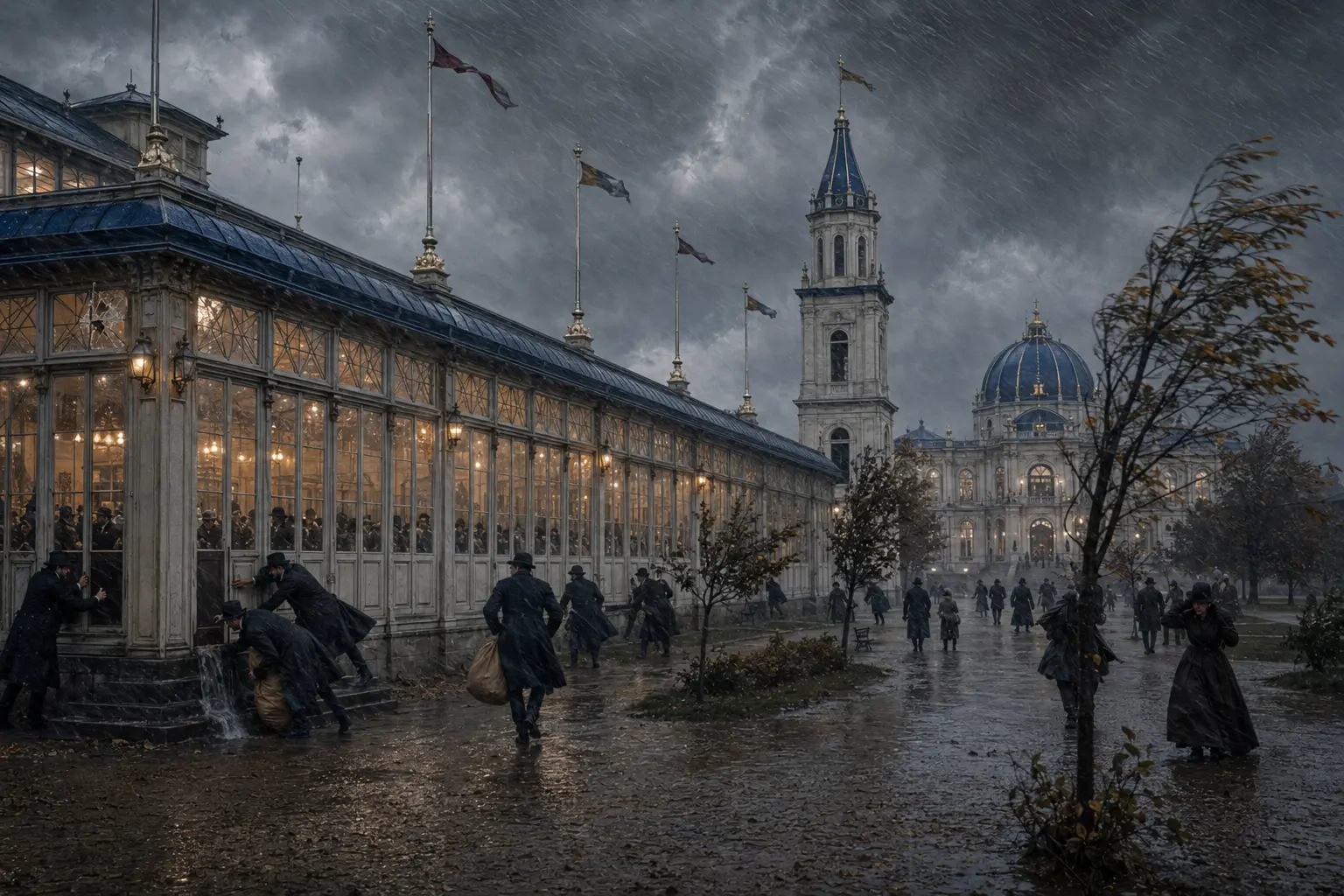
A silent crowd gathered inside the Observatory Pavilion. Beyond the windows, trees bent and the glazed roof trembled; within, the barometer needle continued its slow descent.
The instrument had not, of course, predicted the storm in the miraculous sense later attributed to it by the city. It had merely performed the task for which it had been made: it rendered a change in the air visible before the human body had learned to feel it.
In the stories repeated afterwards, that distinction soon disappeared.
The following morning the sky was high, cold and perfectly clear. The queue for the Gallery of Instruments reached as far as the central fountain.
The Final Evening
The exhibition closed during the last week of October.
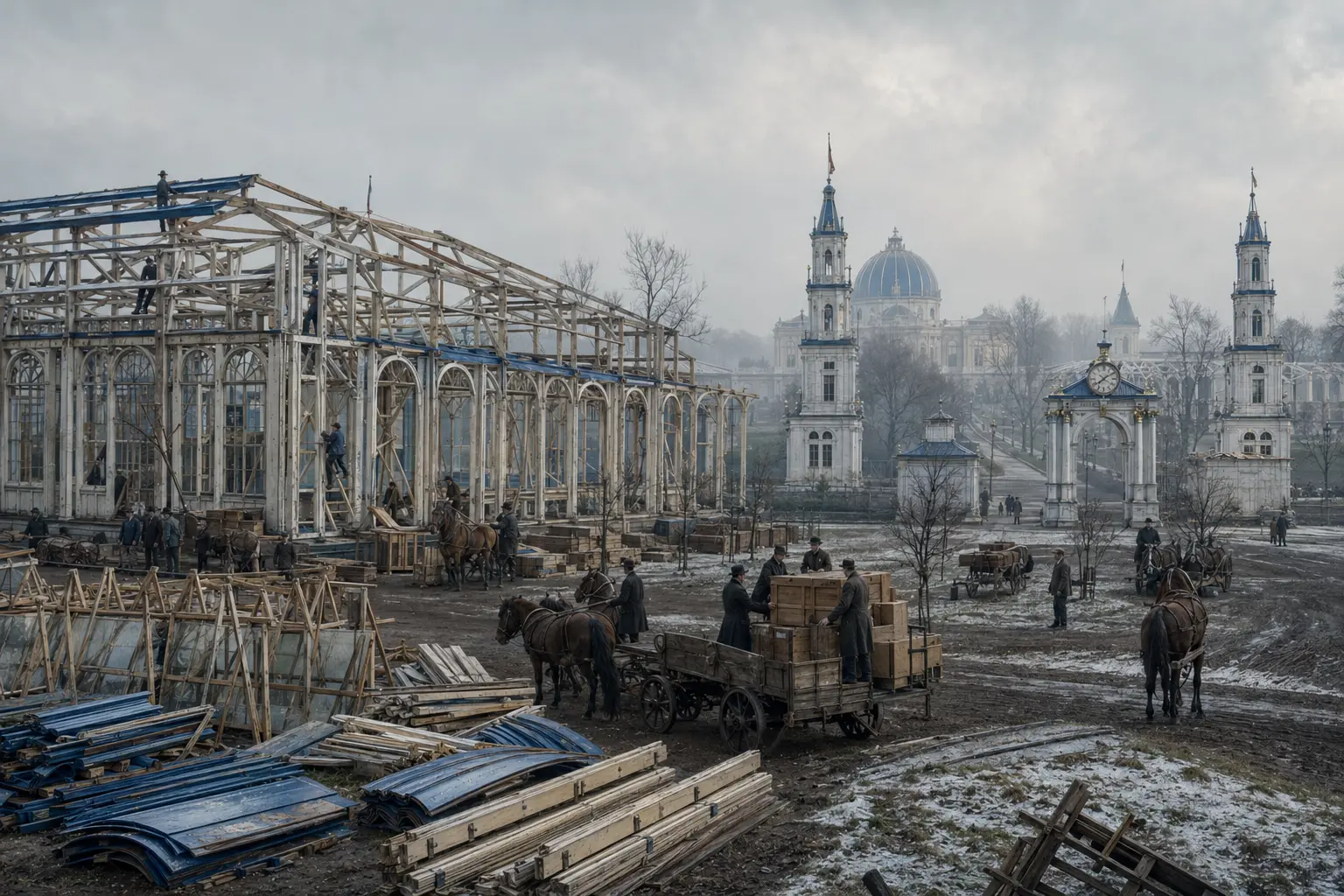
Small objects were removed while daylight remained, leaving pale rectangles upon the walls. In place of certain exhibits appeared handwritten cards: “Sold”, “Returned to the Owner”, “To Be Delivered After Inspection”. The largest machines departed by rail or were dismantled within the halls themselves.
The blue sheets were taken from the roof of the Observatory before the first severe frost.
On the final evening, the exhibition clocks were permitted to run for five minutes beyond the announced hour. The orchestra completed its last piece. The electric lamps failed for an instant, returned, and then began to go out one by one, from the Machine Court towards the principal gate.
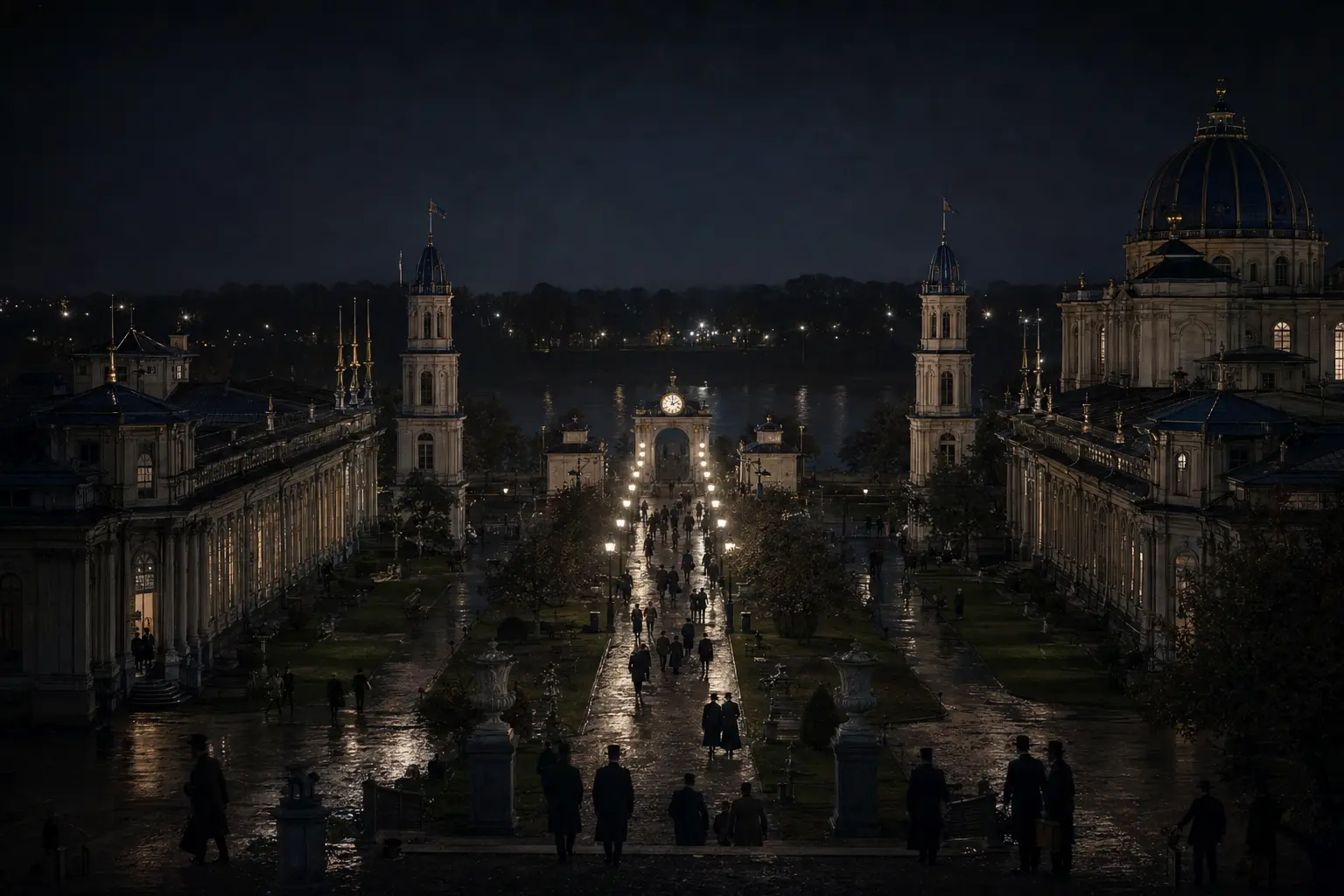
When the final row of white light had vanished, the ordinary lamps of Vilna on the opposite bank appeared peculiarly warm and far away.
By December, only the generating station and part of the eastern gallery remained. Wind from the river crossed the meadow once more. Timber, glass and iron passed into warehouses and workshops. Several blue signs were said to have lain for years in a railway goods shed. Brass entrance tokens continued to be discovered in writing desks and old caskets long after their inscriptions had nearly worn away.
What Remained
The exhibition left behind neither a monumental building nor a permanent institution. Its influence travelled instead through objects too small to enter the chronicles of the city.
Dark wood and blue enamel began to appear in private studies. Scientific instruments were ordered together with furniture rather than hidden in service rooms. Unobtrusive humidity gauges were installed in winter gardens. Railway saloons were finished with the dignity of private chambers.
The great pavilions disappeared, but the objects dispersed from them into houses and workshops acquired a longer life. From workshops they entered drawing rooms, from drawing rooms they passed into attics, and from attics into the collections of people who no longer always remembered where those objects had first been shown.
Vileišis No. 01 remained the chief emblem of that brief northern autumn.
Within it endured the central promise of the exhibition: that precision might enter the home without becoming petty, and that beauty might enter the world of mechanisms without concealing anything or pretending to be a useless ornament.