Vileišis No. 01 was conceived not as a laboratory instrument reduced for domestic use, but as a piece of scientific furniture: a weather station intended to hold the same authority in a private library that a regulator clock held in an observatory.
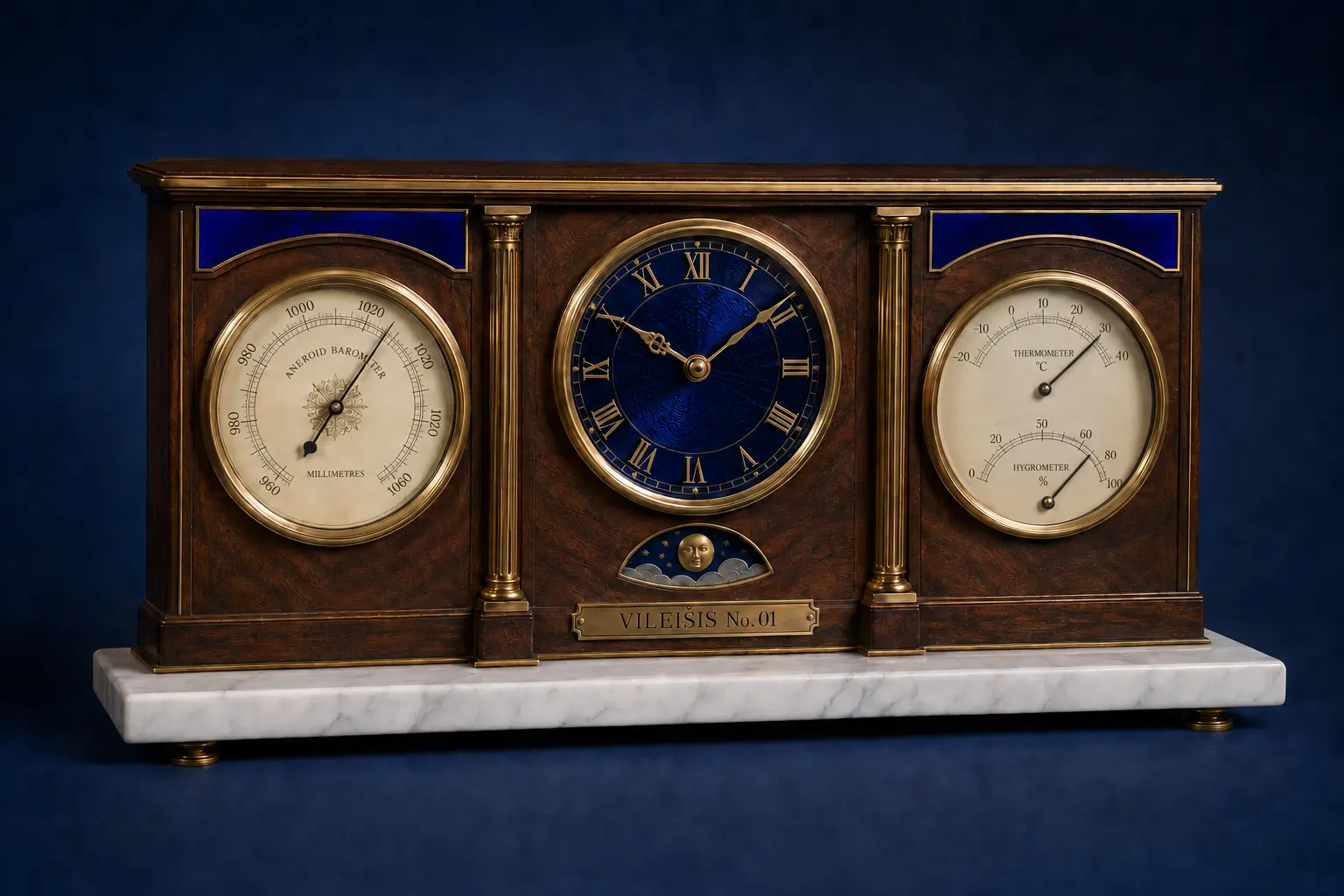
Its low, horizontal case measures approximately 520 millimetres across, 275 millimetres high and 145 millimetres deep. The walnut body rests on a 520 × 175 × 20 millimetre Carrara marble plinth with small brass levelling feet. Thin brass profiles describe the edges without concealing the wood, while two fluted columns divide the face into three measured bays.
Three readings, one composition
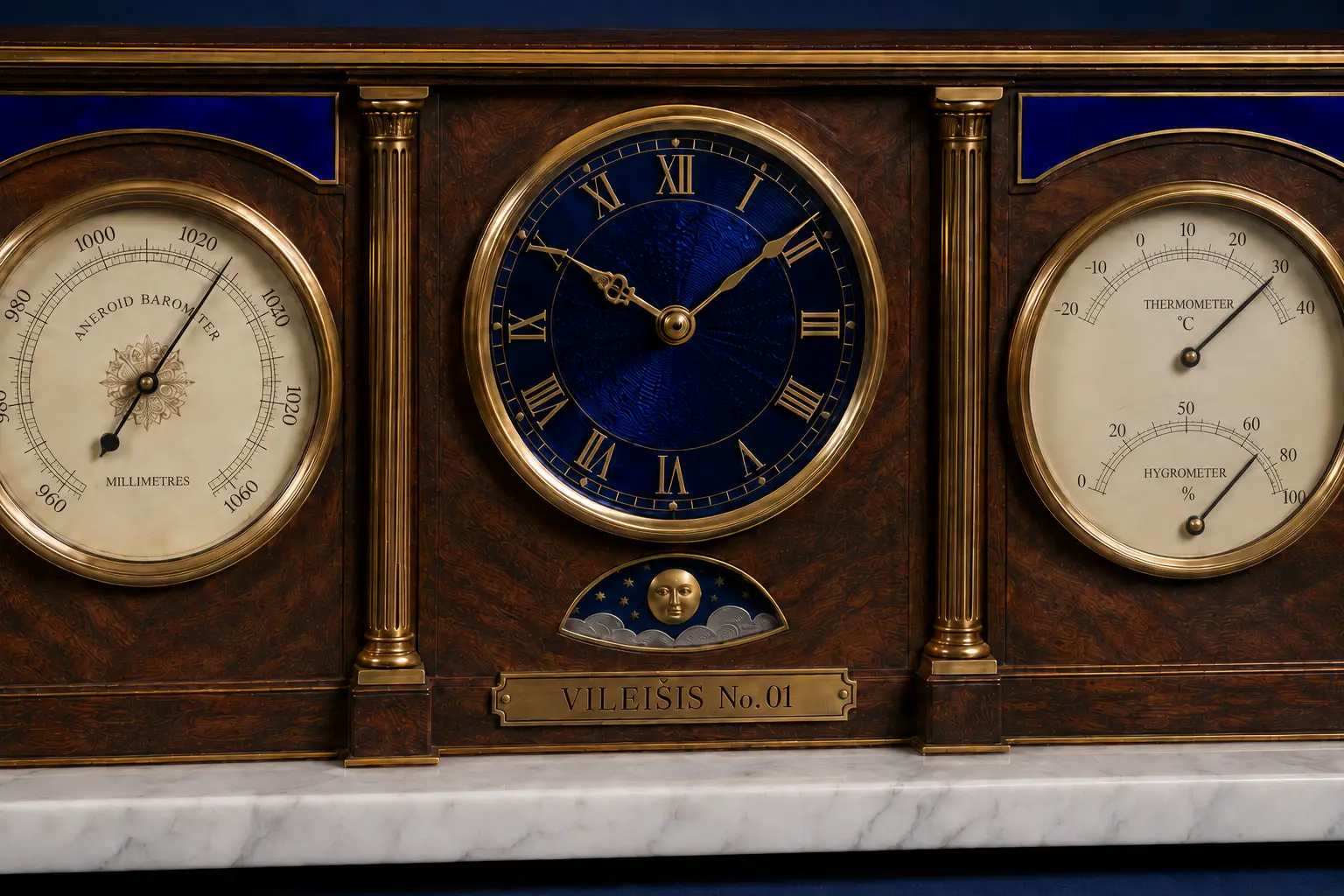
The left instrument is an aneroid barometer, its ivory scale intended to make gradual pressure changes legible at a glance. At the centre is an eight-day mechanical clock with a cobalt guilloché dial. The right instrument combines two independent readings inside a single circular bezel: temperature above and relative humidity below. Its lower hygrometer has a separate pivot beneath an arched scale, allowing one long pointer to indicate a clear percentage rather than float ambiguously inside the dial.
Beneath the clock, a small lunar aperture carries the phase of the Moon and a simplified weather-trend indication. It is not another circular instrument. The window belongs to the central clockwork bay and visually anchors the clock above the narrow plaque marked VILEIŠIS No. 01.
Two cobalt-enamel shoulder panels sit above the outer instruments. They do not continue below the dials or touch the marble. This distinction is part of the object’s fixed construction: the lower edge remains walnut, brass and the single flat stone plinth, without a drawer, pedestal or concealed fourth compartment.
A private commission in the archive narrative
Within the imagined history of the Archive, the instrument was commissioned in 1898 as the first of a proposed series for engineers, physicians and estate libraries. It was attributed to Petras Vileišis and entered under the name Atmospheric Observatory because it gathered the ordinary temperament of a room—time, pressure, warmth, moisture and lunar cycle—into one composed facade.
The word “observatory” was deliberately ambitious. No telescope belonged to the case, and the instrument did not claim to predict weather with certainty. Its purpose was disciplined attention. A falling barometer, rising humidity and a familiar lunar phase could be considered together by an owner who understood that observation was more valuable than theatrical prophecy.
The design’s luxury lies in restraint rather than excess. Brass appears where an edge, bearing, bezel or column benefits from metal. Cobalt enamel is limited to the clock and two upper panels. Walnut provides the continuous architectural body, optical glass protects the three faces, and marble gives the relatively light case a stable, level footing.
The exhibition object
The imagined catalogue for The Vilnius Exhibition of 1898 placed No. 01 between a marine chronometer display and a group of domestic electrical indicators. Visitors were invited to read it from left to right: the weight of the air, the order of time and the condition of the room. The lunar window below the clock completed the composition without competing with the three principal instruments.
Later examples were supposedly planned with alternative woods and enamel colours, but No. 01 established the series grammar. Every surviving view in this Archive therefore preserves exactly three main circular instruments, two columns, two upper enamel panels, one moon window and one marble plinth.
Archive note
This entry is a Speculative Design. Petras Vileišis (1851–1926) was a real Lithuanian engineer, publisher and entrepreneur associated with railway and bridge construction. The instrument, the 1898 commission, its workshop attribution and its exhibition history are original fictional elements created for The Blue Brass Archive. Background on the historical Vileišis may be found in the Kaunas University of Technology profile.